A First Visit to an In-the-Round Performance
A first visit to an in-the-round performance feels easier when you arrive with time to read the seating, settle your sightline and track the action.
What should you do when the actors can move in any direction and there is no single front to face? For a first visit to an in-the-round performance, arrive early enough to understand the room before the play begins, then let your attention travel with the action rather than trying to watch every seat at once.
Arrive early enough to read the room
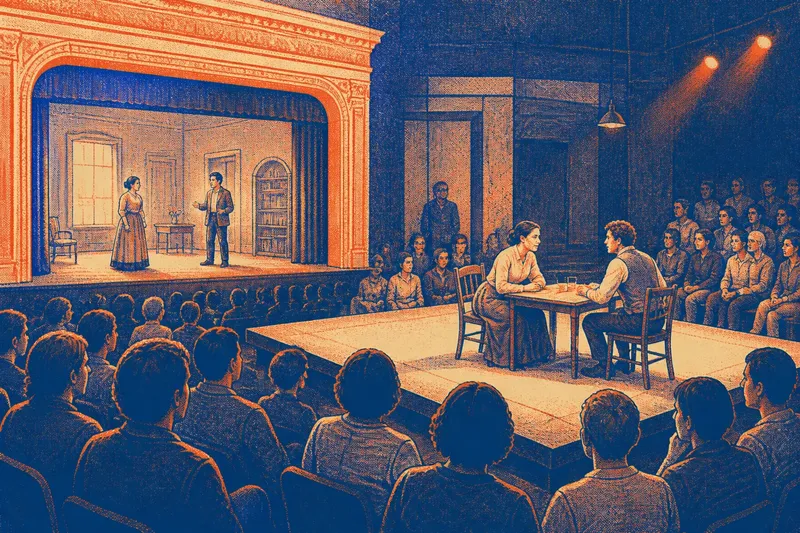
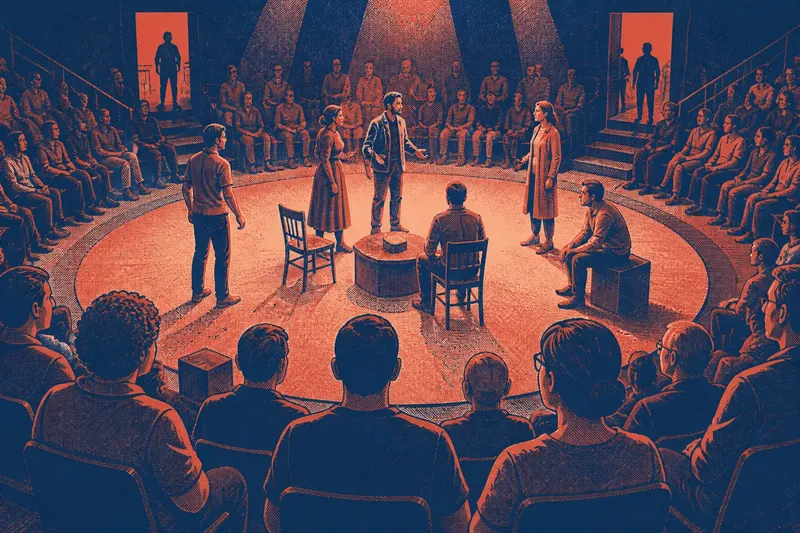
In-the-round theatre places the playing area within an audience that surrounds it. The space might be circular, square or another shape, with entrances and exits positioned around the perimeter. That arrangement changes how you orient yourself: a performer who turns away from your seat is still addressing part of the audience, not necessarily leaving you out.
Give yourself time to find the entrance, check your ticket and locate your seat without rushing. If the venue has a foyer map or a member of staff available, ask where the playing area begins and whether the seating is allocated. Avoid assuming that every venue uses the same layout or entry routine.
Once inside, pause before settling. Look for the boundaries of the acting space, the routes actors may use to enter, and any objects or platforms that divide the floor. A low platform, a central table or an open aisle can shape movement as strongly as a conventional stage edge.
Use the early minutes to orient yourself, not to guess the story.
Choose a seat for the view you want
If you can choose, think about what kind of view helps you follow performance. A seat near the centre of one bank may give a clear look across the space, while a position near a corner can make diagonal movement and entrances on two sides easier to see. Neither is automatically best; the design and your own preferences matter.
Check whether the seating is tiered or level. In a level arrangement, a taller person or a performer standing close to you may briefly block someone farther away. On raked seating, you may have a clearer view of the floor, though the distance and angle will still differ across the room.
Think about access and comfort as well as sightlines. If you need step-free access, space for a mobility aid or a particular type of seat, contact the venue in advance and ask what is available. If seats are unassigned, follow the venue’s instructions rather than moving into a place that appears empty.
Choose the seat that lets you stay attentive without straining.
Settle your attention before the opening
In an end-on theatre, the frame of the stage often tells you where to look. In the round, the frame is less fixed. Before the performance starts, notice how much of the playing area you can see without turning your head, and which parts sit at the edge of your vision.
Put away anything that will pull your attention from the actors. Keep your phone silent and out of sight, and avoid checking it during a scene. Because performers and other audience members may be visible from many angles, even a small movement can catch the eye nearby.
It can help to pick a relaxed resting point: the centre of the playing space, for example, or the area where the actors first gather. Treat it as a place to return to when the stage becomes busy, not as a spot you must watch throughout the show.
At the start, let the room show you its own pattern.
Follow the action without chasing every movement
When the action shifts, follow the person or object that changes what is happening. That may be a speaker, but it could also be a listener whose response alters the scene, or a prop passed from one performer to another. Watching the exchange often gives you a clearer sense of the moment than tracking every actor equally.
Use sound as a guide when someone speaks from outside your direct line of sight. In a compact room, a voice can draw attention towards an entrance or a section of the audience. Turn naturally if the action moves behind you; there is no need to hold a fixed forward-facing posture.
Some movement will happen at once in different parts of the space. You cannot follow everything, and the production may be designed for each audience member to have a slightly different view. Notice the main action first, then allow yourself to register secondary activity when it is easy to do so.
Imagine that a character carries a letter from one side of the stage to another while two people continue speaking across the centre. You might follow the letter because its arrival will change the conversation, then look back to the speakers as they react. The useful result is a readable chain of cause and response, rather than a strained attempt to take in every corner.
Read sightlines and shared space as the scene changes
Actors may turn towards one section of the audience for a line, then redirect their attention elsewhere. That shift is part of the staging, not an instruction to read the line as private or exclusive. Watch how the performer’s body, voice and movement relate to the other characters, and let the address to the audience remain one element among them.
In-the-round staging can make small physical choices legible: a hand held back, a chair turned away, or a performer pausing at the edge of the playing area. It can also mean that an actor’s face is visible to some seats and not others. If you lose an expression, attend to posture, timing and the responses of the people around the actor.
Do not treat the audience as an obstacle to the performance. A brief glimpse of someone across the space can remind you that the room is shared, but the action still belongs to the scene. Keep your reactions considerate and avoid leaning into an aisle or shifting repeatedly to improve your view.
What should you do if you lose sight of an actor?
Stay with the scene’s sound and the reactions of the other performers. An actor may be speaking from behind you or temporarily obscured by the set, and the staging can still make their role clear through a reply or a change in attention.
Is a seat near the centre always best?
No single position suits every room. The shape of the seating, the height of the playing area and the production’s patterns of movement all affect the view, so choose for comfort and a sightline you can maintain.
Should you turn around when action moves behind you?
Yes, if turning feels comfortable and does not obstruct another person. In a round space, the action may move around the audience, and following it with a natural movement is part of watching.
What if the actors face away from your section?
Keep listening and notice how the actors relate to one another. A performer facing another part of the room is still playing the scene, and voice, gesture and the other characters’ responses can carry the moment.
Leave room for the performance to surprise you
After the show, you may remember a moment that another person seated elsewhere experienced differently. That difference is part of the form: the audience surrounds the action, so each position offers its own angles and occasional blind spots.
If you are planning a first visit to an in-the-round performance, the central preparation is simple: arrive with time, settle into your seat, and follow the action as it moves. You do not need to master the room in advance; a little orientation lets you give the actors your attention once the scene begins.
When you leave, notice which entrance, gesture or exchange stayed with you. That small recollection can help you choose a seat and settle more confidently the next time you enter a theatre built around its audience.