Thrust or Proscenium: Two Ways a Stage Faces Its Audience
Compare thrust and proscenium stages to read sightlines, performer proximity and scene focus from your seat, and notice how each layout changes a play.
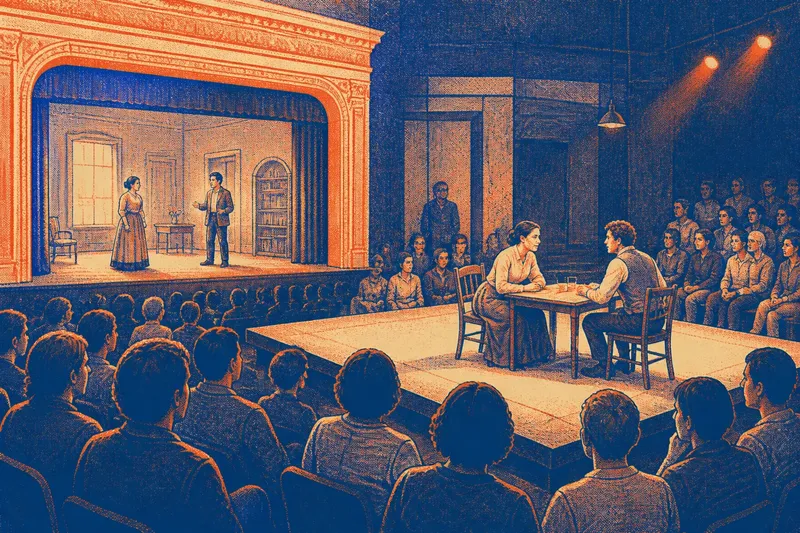
From the side of a thrust stage, you may see an actor’s profile while the audience opposite sees a face; from a proscenium seat, the whole scene sits within a frame. That difference is the first thing to notice when comparing thrust or proscenium stage layouts: each arrangement gives the audience a distinct view of the same performance.
A proscenium stage frames the action
A proscenium stage places the audience on one side of the playing area, looking through an architectural opening or an implied frame. The arrangement resembles a picture: performers face the auditorium, and the stage’s depth extends away from most viewers in roughly the same direction.
From many seats, this makes entrances, furniture and groups of actors relatively easy to read together. The frame can also conceal backstage activity and allow scenery to create a composed view, though a set wall or tall object may still hide part of the action from seats near the edge.
Watch how actors turn their bodies. A performer who faces front may make a line or expression available to a broad part of the house, while a turn towards another actor can briefly give some seats a profile or the back of a head. The framed view can make such choices feel like shifts in emphasis.
Before the performance, notice the edges of the opening and any visible side walls. They offer a quick clue to how much of the set is deliberately hidden from view.
A thrust stage puts viewers on several sides
A thrust stage projects into the audience, leaving viewers on three or more sides of the playing area. Its shape can make performers feel physically near, but there is no single front from which every face and gesture is equally visible.
An actor addressing one bank of seats may show a shoulder or profile to another. A group arranged in a neat line for one side could appear crowded or partly obscured from a different angle. The actors often need to share their attention around the space without making every line sound mechanically aimed at a new section.
Look for how the production uses the centre and edges of the thrust. A chair placed in the middle may be visible to most viewers, while a small object held close to an actor’s body can disappear behind a hand or another performer from certain seats. Proximity does not remove the need to follow the composition.
When you arrive, identify the playing area’s open sides. You can then notice which scenes move across the stage and which settle into an arrangement that favours one view.
Sightlines depend on the seat as well as the layout
“Thrust” and “proscenium” describe broad arrangements, not a promise that every seat offers the same picture. In a proscenium house, a seat far to one side can make a doorway or a section of scenery harder to see; in a thrust space, the nearest audience bank may have a clearer view of an object than the opposite bank.
Obstructions also come from the performance itself. A tall actor can block a seated person’s view of a shorter performer; a table, pillar or costume may conceal a hand gesture. The staging might be arranged to accommodate these limits, but a viewer should still distinguish what is visible from what is merely implied by the dialogue.
Imagine you are seated at the end of a thrust and two characters speak across a narrow table. One character’s face may be clear while the other turns away from you. The useful thing to follow is not only the expression you can see, but also the other performer’s timing, posture and response; the scene can remain legible through those cues.
If choosing a seat, consult the venue’s seating plan and any view notes, then consider whether you prefer a broad frontal picture or the immediacy of a nearby performer. The exact view depends on the room and production.
Closeness changes what feels exposed
In a proscenium theatre, separation between stage and auditorium can make the action feel deliberately presented. A performer’s glance outward may read as a direct address, a moment of private thought made visible, or simply a way to project towards the house; the scene’s style gives the cue its meaning.
On a thrust, faces and small movements can feel nearer because some viewers sit close to the playing space. That nearness may sharpen awareness of breath, stillness and the effort of listening. It can also make a performer’s back more noticeable when they turn towards another side of the room.
Neither layout automatically makes a performance more intimate. A large, open gesture can suit a proscenium’s framed view, while a restrained exchange may feel absorbing on a thrust. Notice whether the actors’ scale and focus seem designed for the room rather than judging closeness by distance alone.
What should you look for from your seat?
Where is the main focus of a scene?
Follow the actor who initiates a movement, holds the group’s attention or changes the subject, then see whether the composition supports that focus from your angle. On a thrust, the focus may travel between audience sides; in a proscenium, it may collect within the frame.
Can you see the listeners as well as the speaker?
Listeners often reveal a scene’s tension through stillness, a shift in posture or a glance. If the speaker is easy to see but the responses are hidden, listen for changes in pace and notice when the staging turns the group into view.
What happens when an actor turns away?
A turn can direct attention towards a partner, leave some viewers with a profile, or make a gesture visible to a different bank of seats. Notice whether the turn changes the emotional distance between characters as well as your own view of them.
Which details survive the distance?
Large changes in posture and movement tend to register differently from a small object or a subtle facial expression, especially from farther seats. Track the features you can read clearly, and let dialogue, sound and the reactions of other performers fill in what the view does not show.
Read the staging without expecting one perfect view
Thrust or proscenium is a useful distinction, but the production’s choices remain visible within either layout: where a scene gathers, how actors share their attention and which details are offered to different parts of the house. A seat gives you one perspective, not the whole design.
For your next visit, take a moment before the action begins to map the stage’s open sides and the nearest likely obstructions. Then watch how performers adjust their focus as scenes unfold; that simple habit makes the relationship between stage and audience easier to see.