The Stage Direction Is Not a Secret Code
Stage directions in plays can guide action without prescribing one hidden answer; learn to separate firm instructions from choices a production can interpret.
When you read a stage direction such as “She turns away”, you may wonder whether the actor must turn at that exact moment, or whether the words point towards a larger change in the scene. Stage directions in plays do not all carry the same authority: some define what must happen, while others leave room for a production to decide how it happens.
That distinction matters to readers, actors, directors and writers. Treat every direction as a code with one solution and you can flatten a scene; treat every direction as optional and you may erase the writer’s design. A week of close reading can help you tell the difference without turning interpretation into a hunt for a hidden answer.
Begin by noticing what a direction actually asks for
On the first day, read a short scene once for its dialogue and once for its directions. Do not decide what the writer “really meant” yet. Mark each direction with a simple question: does it name an event, prescribe a method, or suggest an effect?
“The door slams” names an event. “He crosses to the window” gives an action and destination. “She speaks bitterly” offers a quality of delivery, but does not specify how an actor must produce it. These differences are useful clues, not a complete ranking: a seemingly small direction can carry a large consequence, while a vivid adjective may permit several approaches.
Try separating the words on the page from the picture they produce in your mind. If the direction says “He takes the letter”, the text requires the letter to change hands; it does not necessarily require a particular grip, facial expression or pace.
On the second day, sort instructions from possibilities
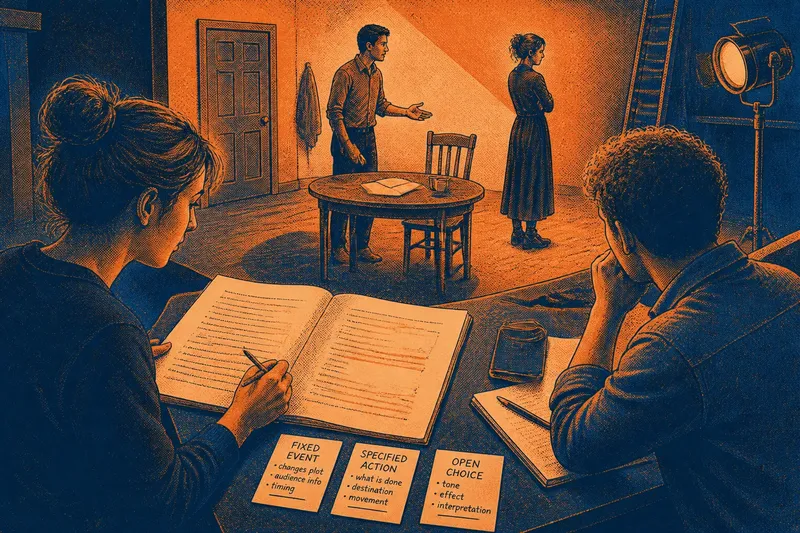
Make three columns in a notebook: fixed event, specified action and open choice. Put a direction in the first column if removing it would change a concrete event in the scene; use the second when the script specifies what a character does, but not every detail of how; use the third for descriptions that suggest tone, atmosphere or an audience effect.
This is a working tool, not a verdict about the writer’s intentions. A direction may sit between columns. “A laugh escapes him” requires a laugh, yet leaves open whether it is nervous, delighted, cruel or involuntary. If the distinction matters, record the ambiguity rather than forcing a single answer.
Imagine you are reading a scene in which a character sets a cup beside an unopened letter, then says, “I thought you’d be home.” The cup and letter are concrete props and actions; the line’s emotional temperature is less fixed. An actor might deliver it with relief, accusation or guarded politeness, and each choice could remain consistent with the written action. The observable result is a scene that preserves the same event while changing the relationship the audience perceives.
On the third day, test what changes if you remove a direction
Choose a direction and temporarily cover it with a slip of paper. Read the scene without it, then restore it. Ask what changed: the plot, the timing of an action, the audience’s knowledge, or only the mood you imagined. This small comparison makes the direction’s practical work easier to see.
If removing “She hides the key” makes the later discovery unintelligible, the action is probably essential to the scene’s mechanics. If removing “with a strange calm” leaves the events intact, that quality may be an interpretive invitation. It still matters; it simply does not dictate one visible or audible solution.
Do not assume that a direction is unimportant because an actor can vary it. A line such as “He does not answer” may be more decisive than a detailed description of the room. The useful question is not whether a direction is mandatory in every production, but what dramatic information would be lost if it were ignored.
On the fourth day, look for what the surrounding scene supports
Read the lines before and after each ambiguous direction. A direction gains meaning from the scene’s sequence: a character who “smiles” after a threat may be masking fear, enjoying control, or trying to reassure someone. The next line, the other character’s response and the immediate action can narrow the field without reducing it to one answer.
Keep evidence and interpretation in separate notes. “She smiles after he says he will leave” is an observation; “she is relieved” is an interpretation. The distinction gives a director or actor something concrete to discuss while leaving room for a different, equally supported reading.
Look for patterns as well as isolated cues. If a script repeatedly places a character near exits, that pattern may be worth considering, but it does not automatically mean the character intends to flee. Gather the moments first; propose a meaning only when the pattern helps explain the play’s action.
On the fifth day, compare the direction with the play’s practical demands
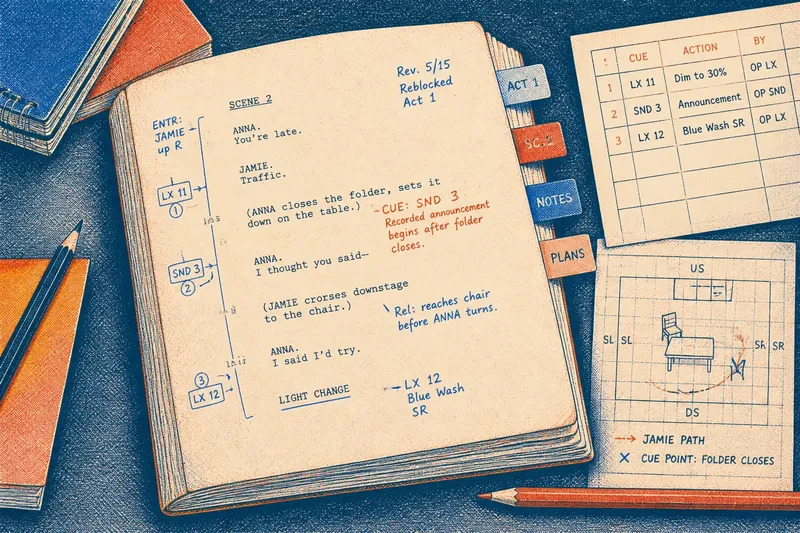
Some directions are tied to the conditions of performance. A character enters through a named door; a letter is visible to the audience; a sound interrupts a line. These details may affect entrances, props, sightlines or cues. A production can sometimes solve them differently, but the alternative still needs to preserve the dramatic information the text supplies.
Other directions describe an image that a stage may realise in more than one way. “The room grows smaller” could suggest a change in scenery, a tightening pool of light, the actors drawing closer, or an audience’s altered sense of the space. The phrase offers a theatrical idea, not necessarily a shopping list of equipment.
When a direction appears to demand a technical effect, ask what the audience needs to understand. A sudden blackout might mark a break in time, conceal a change, or end a scene. Knowing the function helps a team discuss practical options without mistaking one imagined mechanism for the only possible staging.
On the sixth day, discuss alternatives without losing the text
If you are working with others, bring two plausible readings to the table rather than asking everyone to guess the correct one. Tie each reading to a word, action or relationship in the scene. This keeps discussion grounded and makes disagreement useful: people can compare what each choice clarifies or obscures.
Say a direction reads “He offers his hand”. One reading might make the gesture an invitation to reconcile; another might make it a formal demand for the object the other character holds. Before choosing, check the dialogue, the characters’ immediate objectives and what follows. If either staging keeps the hand extended and preserves the next action, the direction may be allowing more than one interpretation.
In a rehearsal room, record the choice made for that scene and the reason for it, especially if the choice affects a later cue or action. This is not a claim that the interpretation is final. It gives the team a clear point to revisit if the scene’s rhythm or meaning changes during rehearsal.
On the seventh day, make a reading note you can use
Return to the directions you marked as uncertain. For each, write one sentence about what the text clearly requires, then list the choices it appears to leave open. Finish by noting what evidence could help distinguish among those choices: a later line, a repeated image, a prop, or the response of another character.
Keep the note short enough to consult. “The character must put the letter on the table; the script does not specify whether this is careful or careless; the next scene depends on the letter remaining visible” is more useful than a paragraph claiming to explain the writer’s psychology.
This week’s routine is not a formula for deciding every direction. It is a way to read precisely before interpreting: identify the action, test its effect, use the surrounding scene, then make a choice that serves the play.
What readers often ask about stage directions?
Are stage directions part of the play’s meaning?
Yes. They can establish action, timing, relationships, setting or an image that changes how dialogue is heard. Their contribution may be firm or open to interpretation, so read them alongside the spoken text rather than treating them as decoration.
Can a director change a stage direction?
A director may develop a different staging when it preserves the scene’s necessary action and dramatic information. The right approach depends on the script, the production’s agreement and any applicable rights or instructions; where those obligations matter, check with the relevant qualified professional.
How can an actor approach an emotional direction?
Start with the action and the character’s circumstances, then consider what the emotional description adds. An actor can explore a playable intention that fits those details without copying an imagined facial expression or vocal pattern.
What if a direction seems impossible on stage?
Identify the effect it serves before deciding how to represent it. A production may be able to suggest the same event through sound, light, movement, a prop or a change in focus, provided the audience can still follow the play.
Read the direction for its work, not for a secret answer
Stage directions in plays are clearest when read as part of the action rather than as clues to a single concealed performance. Some tell the team what must happen; others define a boundary, supply an image or open a choice. Reading carefully means keeping those categories distinct without pretending they never overlap.
When a direction leaves room, use that room responsibly: point to the words that support your interpretation, notice what the scene still requires, and remain willing to revise your view. The most useful reading is not the one that solves the script once and for all, but the one that helps the people making the play act with purpose.