From Prompt Book to Rehearsal Record
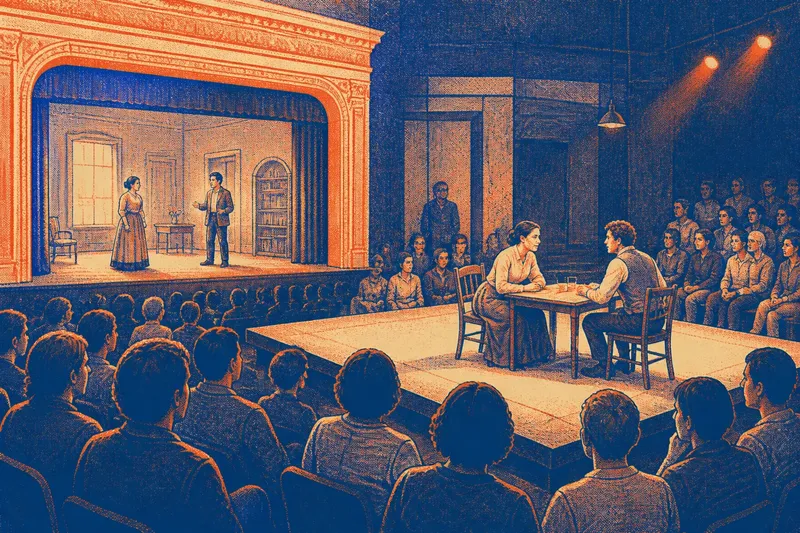
A prompt book keeps cues and staging choices legible across rehearsals, helping the company carry a shared account of how the production works.
What needs to be written down so a production can be repeated without turning a living performance into a set of rigid instructions? A prompt book records cues and staging, but its deeper purpose is to give the company a shared account of decisions: what was chosen, when it happens, and what information the next person needs.
A prompt book joins the script to the event on stage
The script is a record of the play’s words and, sometimes, its initial directions. The prompt book gathers the production’s working version: the script marked with entrances, exits, cues, movement, and other choices made in rehearsal. It may sit alongside a separate cue sheet or digital file, but the documents need to agree.
In many productions, the stage manager maintains this record. Actors, directors, designers and operators may contribute information, while the stage manager keeps it coherent enough to use during performance. The book is not a transcript of every conversation. It captures decisions that affect what happens on stage and the people responsible for making it happen.
Start with the current script and a clear way to distinguish original text from production notes. A pencil, removable tabs and a consistent marking system can help a paper book remain readable as choices change. For a digital record, use clear file names and make sure the working version is identifiable.
Record cues where someone can act on them
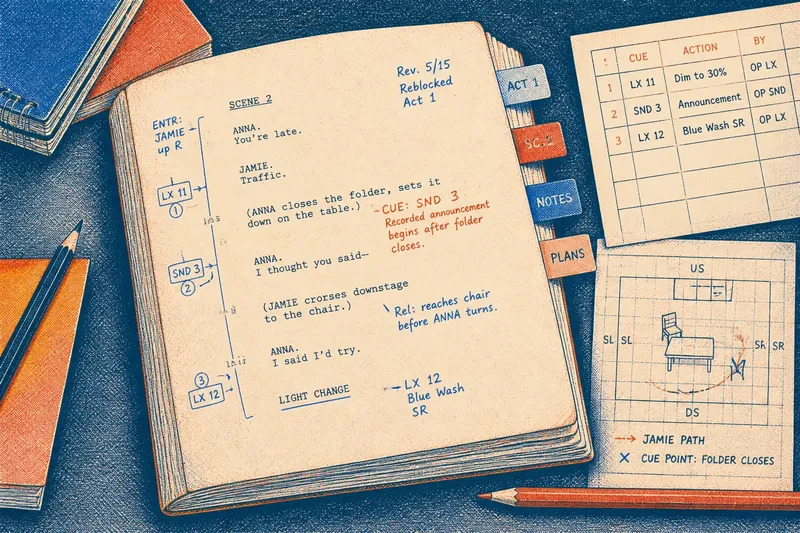
A cue note should locate an event and identify the action it prompts. “Lights” is too vague if several changes occur in the scene. A more useful entry names the cue, places it beside the relevant line or action, and indicates who calls or carries it out. The notation should be agreed by the company rather than assumed to be universal.
The same principle applies to sound, projections, scene shifts and other transitions. A cue sequence may be called from the script while fuller technical details live on a separate sheet. Cross-references help only if they point to a document everyone can find and recognise as current.
Say a company decides that a recorded announcement begins after an actor closes a folder, rather than on a particular line. The stage manager can note the action as the cue point and identify the sound cue beside it; the expected observable result is that the operator and actor share the same trigger even if the line is delivered at a different pace.
Staging notes preserve relationships, not just positions
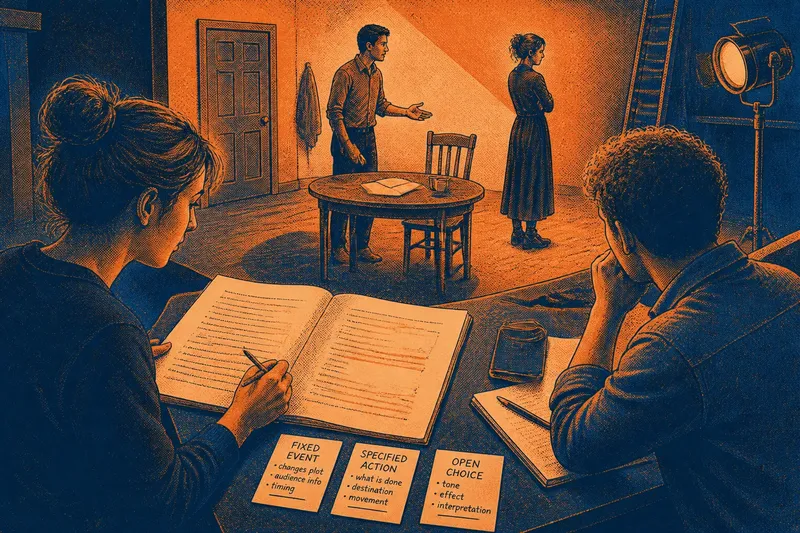
A mark such as “crosses downstage” records direction, but may not explain why the movement matters. If an actor must reach a chair before another character turns, that relationship can be more useful than an isolated map of positions. Notes should capture the playable arrangement: who moves, what prompts the move, and what must remain clear to the audience or crew.
Use plain language and stable stage terms. “Left” can mean the actor’s left or the audience’s left, so a company should establish its convention and use it consistently. A small ground-plan sketch can clarify furniture, entrances and traffic; the script note can then point to the relevant location without trying to redraw the whole stage on the page.
Not every movement needs permanent notation. Record what helps maintain timing, safety, sightlines or a significant relationship between performers and objects. Leave incidental variation alone when it does not alter the agreed shape of the scene.
A shared rehearsal record needs room to change
Rehearsal is a process of making and revising choices. A note that was accurate last week can become misleading after a scene is reblocked. Mark changes clearly: cross out superseded material without making it unreadable, date or identify the revision where useful, and update any linked cue sheet or plan.
It also helps to distinguish a proposal from an adopted choice. A margin note from an early rehearsal should not look as authoritative as the version the company has settled on. One simple practice is to mark tentative ideas as such, then remove or resolve them when the decision is made.
Before a run, the stage manager can check that cue points, entrances and scene transitions match the current script and the company’s agreed staging. This is not a demand for uniformity in every breath or gesture. It is a way to ensure that a change made in one part of the production does not leave another person working from an obsolete instruction.
What should a prompt book include?
Should every actor’s movement be recorded?
No. Prioritise movement that affects entrances, exits, timing, safety, sightlines or a repeatable stage picture. Over-recording small choices can obscure the few notes the company genuinely needs.
How is a prompt book different from a cue sheet?
The prompt book usually places cues in the context of the script and staging. A cue sheet concentrates on the operator’s sequence and technical details; the two records should use matching cue names and references.
Can a prompt book be digital?
Yes, if the format is accessible during rehearsal and performance, changes are controlled, and the company knows which file is current. A printed copy or suitable backup may be useful when devices, access or venue conditions make the digital record impractical.
Who decides what becomes the official record?
The stage manager commonly maintains the working record, but production choices are agreed through the appropriate rehearsal process. The record should reflect those decisions rather than silently making them on behalf of the company.
The record should support the next performance
A useful prompt book is neither a director’s memory aid alone nor a museum of every rehearsal idea. It is an operational account that lets the company recover the agreed shape of the work while leaving performers room to respond in the moment.
For a production moving between venues or returning after a break, the record becomes especially valuable when it explains dependencies: which entrance must stay clear, which action triggers a sound, or what arrangement preserves a sightline. Keep those notes close to the relevant script moment, and make the prompt book a dependable shared reference rather than a pile of private shorthand.